Most people who tell me "shadowing didn't work for me" are not wrong about their result. They are wrong about the cause. They blame the method, quit, and go back to flashcards—when the actual problem is that they were doing something that looked like shadowing but wasn't.
It is a quietly expensive failure. You keep spending the same half-hour a day. You keep feeling like you are practicing. Months pass. Nothing improves. You conclude the method is overhyped and move on, while the person next to you — doing almost the same thing, minus three small errors — breaks through in six months.
I wasted the first two months of my own shadowing on mistake #1. I was not lazy. I had a daily routine. I was sitting there repeating audio faithfully. And I was getting almost nothing out of it, because I had quietly turned shadowing into something else without noticing.
If your shadowing feels stale, slow, or like it has stopped working, these three mistakes are where the leak almost always is. Each comes with a one-sentence self-check and a fix.
Mistake #1: You Are Reading Aloud, Not Shadowing
The transcript is in front of you. The audio plays. Your eyes run ahead of the speaker, you see the next line in print a beat before they say it, and then you say it along with them. Feels productive. Feels like shadowing.
It is not. That is reading aloud with a backing track.
Shadowing only trains your ear if the ear is doing the work. The moment you let your eyes get there first, you remove the entire output pressure that the method is built on. The brain, being efficient, takes the easier path: it reads the words off the page and largely ignores the audio as a timing reference. You finish the session having practiced reading and pronunciation. You have not practiced listening at all.
I did this for the first two months. My shadowing "felt" productive because I was hitting every line. Then I tried the same clip without the transcript and realized I could not follow it. I had been shadowing the text, not the audio. My ear had barely grown.
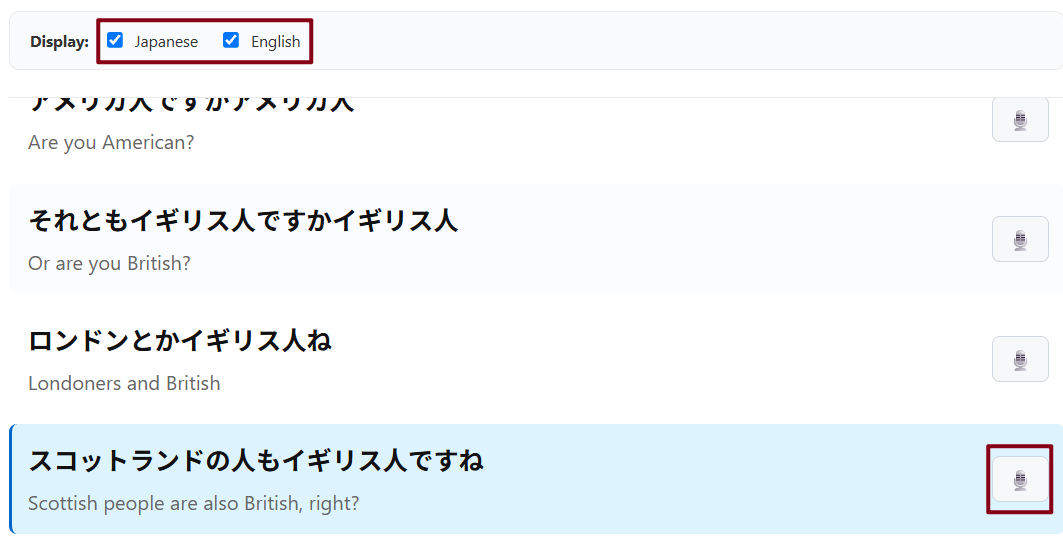
japanese english transcript
If the clip is so far above your level that you cannot follow any line cold, the fix is not opening the transcript. The fix is in mistake #2.
Mistake #2: Your Material Is Too Hard for You Right Now
You pick a podcast, an anime, or a news clip that sounds like "real Japanese," because that is what you want to understand. You shadow it. You pause every few seconds. You feel virtuous because the session was painful and pain must mean growth.
It does not. Pain means you are out of your depth, and you are not training what you think you are.
Shadowing works on audio where you already understand roughly 70 to 80 percent of the words. Below that threshold, your brain cannot process the incoming sound fast enough to reproduce it. You are not shadowing — you are parsing, decoding, and losing a race against the audio. The mouth that comes out of it is producing noise on top of noise, and whatever gets repeated the most gets reinforced the most. You are drilling errors into muscle memory.
This is the single most common reason people quit. They assume shadowing "doesn't work," when in fact they tried to run before they could walk and concluded that running was impossible.
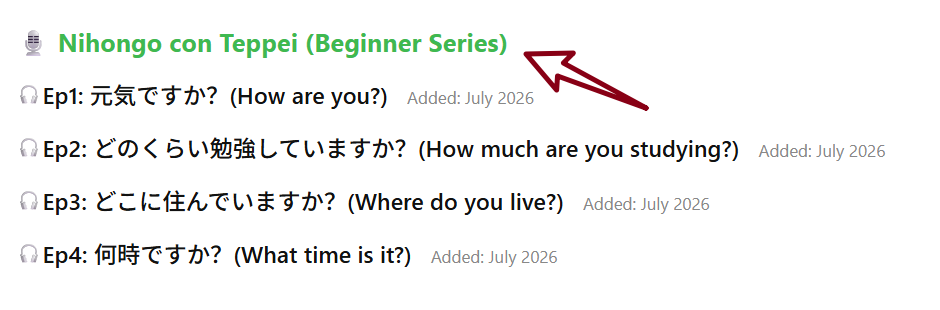
japanese beginner series
Mistake #3: You Never Listen Back to Yourself
You shadow every day. You finish, close the laptop, and feel productive. You have not once pressed record and then listened to your own voice afterwards.
This is the equivalent of practicing free throws with your eyes closed.
The method gives you two feedback channels. One is the model speaker, still ringing in your head. The other is your own output, which you compare against that model. If you never record yourself, you only ever use one. You catch some mistakes in real time — you hear yourself mispronounce something and correct it on the next loop. But you miss the slow, quiet errors that you cannot catch in the moment: pitch patterns that drift, vowel lengths that shrink, a faint monotone that creeps in when you are tired.
I avoided recording for a long time because I hated my own voice. Most learners do. But the first time I actually listened back, I caught two pitch errors I had been drilling into my mouth for weeks. I could not hear them while shadowing. I could hear them clearly the moment I listened back.
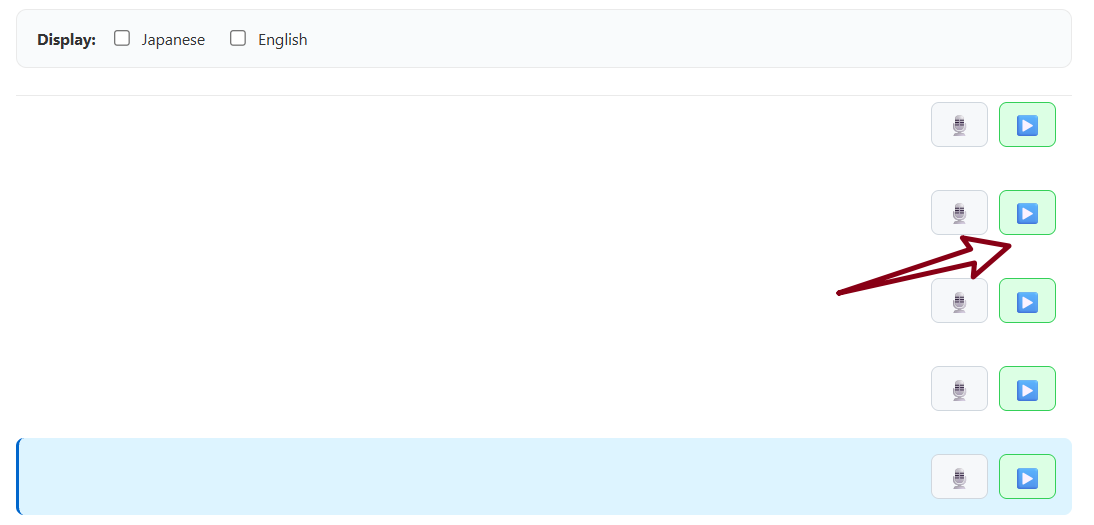
listen back to yourself
How the Three Mistakes Stack Up
If you want to see all three at once:
| Mistake | What it looks like | What you are actually training |
|---|---|---|
| #1 Reading aloud | Eyes ahead of the audio, transcript open | Reading speed. Not listening. |
| #2 Material too hard | Pausing every few seconds, can't keep up | Error reinforcement. Not Japanese. |
| #3 No recording | Never listening back to your own voice | Confidence. Not accuracy. |
Each one, on its own, can waste months. Combined, they can waste a whole year of daily practice and leave you convinced shadowing is a gimmick. The good news: each fix is small, immediate, and free.
What to Do Right Now
If you have been shadowing for a while and feel like you have stalled, do not switch methods. Run the three self-checks above, fix whichever one applies, and commit to the corrected form for two weeks. Most stalls are not a motivation problem or a talent problem. They are a form problem. Fix the form, and the method does what it is supposed to do.