A year ago, I arrived in Japan not even knowing how to say "こんにちは" or read basic Hiragana.
For the first six months, I was in pure agony. Sitting in Japanese language classes, I completely failed to keep up with the teachers' pacing. My brain couldn't process the spoken words fast enough.
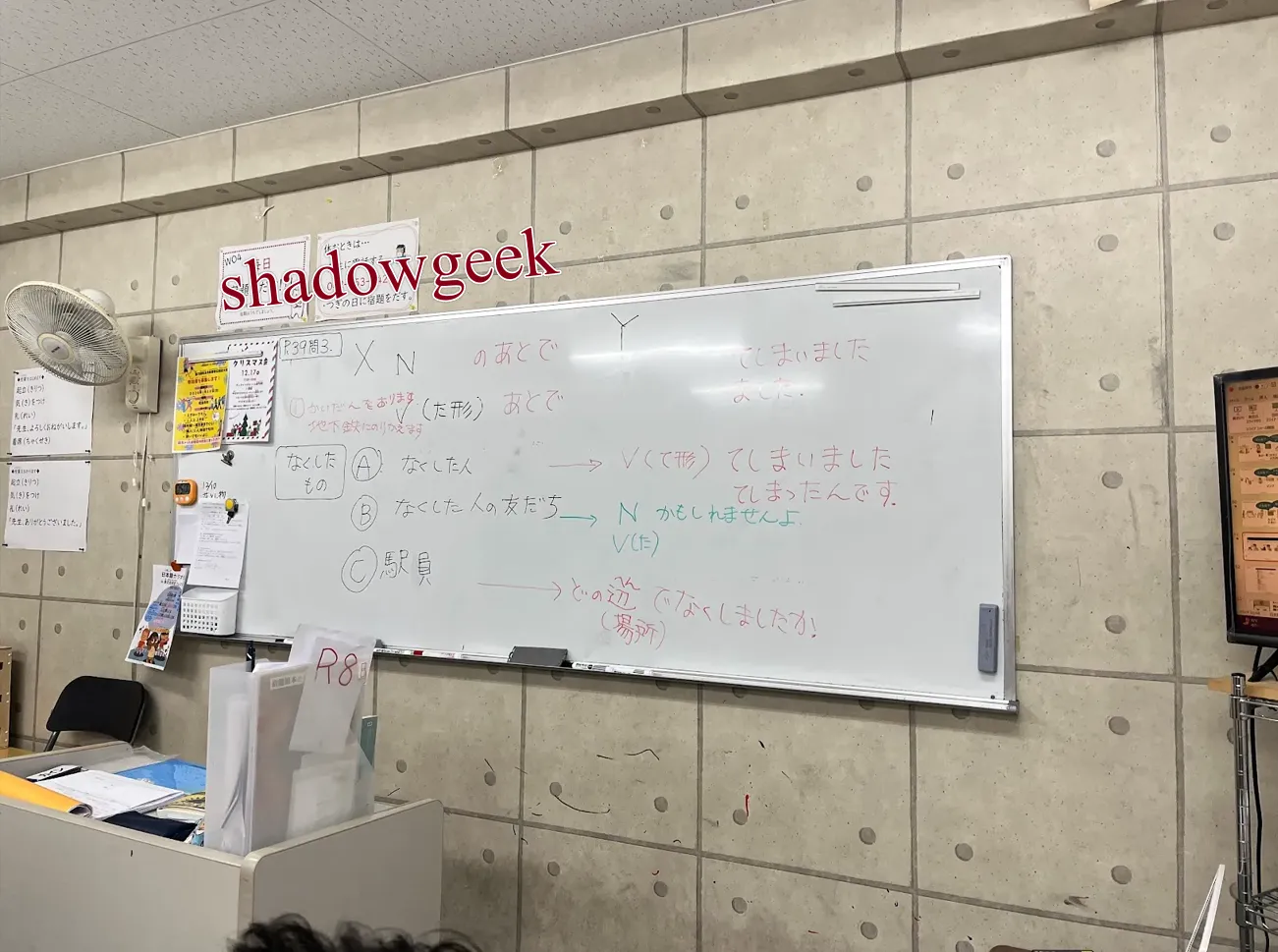
📸 Japanese Language School
Like many learners, I doubled down on textbook grammar. But here is the brutal truth: studying grammar is fantastic for passing the JLPT, and my test scores certainly improved. However, grammar study did absolutely nothing for my conversational speaking. I was still struggling to string a sentence together at a convenience store.
Desperate to break out of this situation, I threw away the textbooks and started hardcore Shadowing for 2 hours every single day.
Six months later, the breakthrough happened. Suddenly, I could understand everyday conversations in anime without subtitles. I was catching the core meaning of fast-paced sentences. My teachers were shocked by my rapid progress, and when I told them I still felt my deep conversational skills were lacking, they simply said: "Don't worry. Keep your momentum, keep shadowing, and in another six months, you will see an explosive leap."
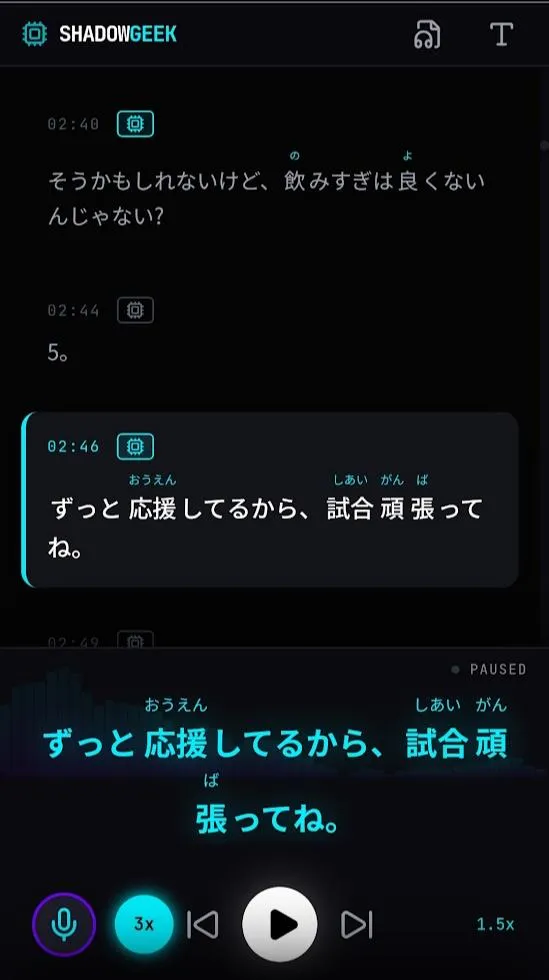
📸Japanese Shadowing
Last month, having secured my solid N3 foundation, I left Tokyo and returned home. I lost that 24/7 immersive Japanese environment practically overnight. But my passion hasn't faded. I brought the hardcore Tokyo shadowing routine back with me, executing it relentlessly every single day—no matter where I am.
I wrote this article to kill your self-doubt: Even if you are not in Japan, shadowing can completely save your spoken Japanese. If you are stuck in the intermediate plateau and wondering if shadowing actually works, here is the honest evidence—not the hype version, not the "just talk more" version.
Why You Are Stuck: The Output-Comprehension Asymmetry
If you are browsing Reddit threads reading comments from frustrated learners who want to quit, you are likely experiencing what I call the "Output-Comprehension Asymmetry."
You know the N4/N3 grammar rules in your head, but the pathway from your brain to your mouth is too slow. Traditional studying only trains your declarative memory (knowing facts). Speaking requires procedural memory (muscle memory). This is why you can pass N3 and still freeze up at a konbini. The two skill sets are wired in completely different parts of the brain, and reading more grammar rules does not wire the speaking one.
This is also why "just talk more" advice is so painful to hear when you are in this phase. It is not wrong—you should talk more—but it skips over the actual problem: when you try to talk more, you produce slow, broken sentences, and those broken sentences get reinforced instead of fixed. You need a way to load correct, native-speed patterns into your speech output before you try to generate them yourself. That is what shadowing does.
What the SLA Research Actually Says About Shadowing
Shadowing is not a trendy internet hack. It has been studied in Second Language Acquisition (SLA) research for over two decades, mostly in the Japanese-as-a-second-language field. If you have heard people cite "Kadota's research on shadowing," they are usually pointing at one body of work by Sadaaki Kadota, whose research monograph Shadowing as a Practice in Second Language Acquisition brought together years of experimental work on what happens in the brain when learners shadow Japanese audio.
The short version, stripped of jargon: shadowing forces your brain to run input and output at the same time, which is something normal studying never demands. Kadota's work identifies four processes that fire in parallel while you shadow:
- Perception: you have to decode the incoming sound in real time. There is no pausing, no rewind. Your ear has to keep up.
- Reproduction: you immediately reproduce what you heard, matching speed and rhythm. This is the output demand, and it is what separates shadowing from passive listening.
- Monitoring: while you speak, you compare your output against the model still ringing in your head. You catch mismatches in pitch, timing, or vowel length—and correct them on the next pass.
- Consolidation: the repeated loop moves chunks of sound from slow, conscious processing into faster, automatic retrieval. This is the part that actually rewires your procedural memory.
Here is the part most blogs skip: shadowing's strongest, most-replicated effect is on listening comprehension speed, not on free conversation ability. Studies measuring learners who shadowed for a few weeks consistently show gains in how fast they can process spoken input, and clear improvements in pitch accent production. That is real. That is measurable.
What the research does not claim is that shadowing alone makes you a fluent conversationalist. It builds the engine—fast input decoding and native-like sound production—but it does not teach you how to handle an unexpected reply, negotiate meaning, or repair a conversation that is breaking down. Those are different skills, and they require actual conversation practice.
What Shadowing Does and Does Not Do (Be Honest About This)
If you go in thinking shadowing is a magic pill, you will quit in three weeks when you are still not fluent. So let me separate the real from the hype, based on both the research and my own 200-plus hours of doing this:
| Shadowing DOES | Shadowing Does NOT |
|---|---|
| Sharpen your listening speed—you stop needing people to repeat themselves. | Teach you new vocabulary from scratch. You must shadow audio where you already understand most of the words. |
| Build pitch-accent awareness so you stop sounding flat. | Make you good at unscripted conversation. That is a separate skill. |
| Turn your slow, conscious grammar knowledge into automatic, usable output. | Fix fossilized errors on its own. If you have been saying a word wrong for years, shadowing can ingrain it further unless someone flags it. |
| Train your mouth muscles to produce Japanese sounds without straining. | Replace feedback from a real human. You still need someone to catch what you cannot hear yourself. |
The people who claim "shadowing did nothing for me" almost always fall into one of two camps: they shadowed audio far above their level (so they were just producing noise on top of noise), or they expected it to make them conversationally fluent with zero speaking practice. Both groups misunderstood what the method is for.
Shadowing vs. Other Methods (The Decision Framework)
If you are thinking about giving up or switching methods, review this comparison before you decide:
| Practice Method | What it trains | Limits | Best For |
|---|---|---|---|
| Shadowing | Listening speed, pitch accent, automatic output. Solo, free, repeatable. | High focus cost. Drains you in 20-30 minute sessions. | Breaking the intermediate speaking plateau when you cannot get daily conversation. |
| "Just Talk" (iTalki, exchange) | Real-time thinking, repair, negotiation of meaning. | Expensive; you often repeat the same mistakes without correction unless your partner is a teacher. | Building conversation confidence once you already have something to say. |
| Textbook / Grammar Study | Declarative knowledge. Great for JLPT scores. | Zero impact on conversational speed or understanding real speech. | Beginners building foundation and exam prep. |
| Passive Immersion (podcasts, anime) | Input volume, habit, motivation. | Without output pressure, you stay a good listener who cannot speak. | Complementing an active method, not replacing one. |
Notice the pattern: none of these methods is complete on its own. The learners who actually break the plateau combine an output-focused method (shadowing) with a real-interaction method (conversation) and a knowledge method (grammar). The mistake is doing only one.
The 6-Month Realism Check
You will not see results in a week. I did not, and neither will you. Based on my own daily log and what I have seen in SLA studies, here is the timeline you should actually expect at 30-60 minutes a day:
- Month 1-2: Your mouth gets tired. You stumble over fast syllables. It feels awkward and you will question whether this is doing anything. Keep going. This is the perception and reproduction loop forming.
- Month 3-4: The shift starts in your ears. You begin catching the natural rhythm, the filler words, the pitch movement that you used to miss entirely. Native speech stops sounding like one long blur.
- Month 5-6: The breakthrough. Fast dialogue slows down in your head. You can mimic native speed without consciously parsing each word. This is where people around you start noticing.
- Month 6+: The compounding phase. Each new audio clip takes less effort to shadow, and your shadowing speed starts pulling your conversational speed up with it. This is the "explosive leap" my teacher promised.
Why It Still Works After You Leave Japan
When I left Tokyo, the thing I was most worried about was losing the immersive environment. In practice, the opposite happened. My shadowing routine did not depend on Japan at all—I had been doing it solo, with headphones, the entire time. The conversations I had in Tokyo were the reward, but the engine that made them possible was the daily solo practice.
If anything, my routine got more consistent after I left, because there were fewer distractions. The lesson I want to pass on: do not wait until you "go to Japan" to start. The people who arrive and progress fast are usually the ones who were already shadowing at home for months. They had the engine; Japan just gave them more chances to drive it.
Action Step: Shadow With Me
If your goal is to seamlessly understand native Japanese, watch raw anime, and speak without mentally translating, do not let the lack of a "Japan environment" stop you. I built a small library of interactive shadowing materials based on the exact audio clips that helped me break my plateau—pre-sliced native-speed audio with dual-language transcripts you can loop line by line.
Stop doubting, and start practicing with me in the Shadowing Lab today. If you want to understand what you are doing before you start, the 10-minute beginner's guide walks through the method from scratch.